


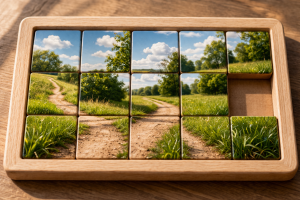
There is something quietly satisfying about a sliding puzzle. No noise, no rush — just a small board, a few pieces, and the gentle challenge of putting everything back in place.
A sliding puzzle is simple in its idea. The pieces move within a fixed frame, and there is always one empty space that allows everything else to shift. You slide one piece, then another, and slowly the image begins to make sense again. It often feels easy at first, but once you begin, you realise it asks for a bit of patience and a calm kind of attention.
Sliding puzzles have been around for quite a long time. One of the earliest and most well-known versions is the 15 puzzle, which became popular in the late nineteenth century. It was a small square with numbered tiles, yet people quickly became fascinated by it. Something so simple could hold your attention for far longer than expected, and it quietly spread from homes to cafés and workplaces.
The idea has not really changed since then. Today, instead of numbers, you might find a picture slowly coming together — perhaps a piece of artwork, a photograph, or even something as unusual as a page of music. The materials may have changed, and many puzzles now exist on screens instead of in your hands, but the feeling is still the same.
What makes a sliding puzzle special is the way it slows you down. You look at the pieces, you move one slightly, you adjust, and then you pause for a moment to see what has changed. Without really noticing it, you become focused. Your mind begins to follow the shapes and positions, gently working out where each piece belongs. It is not a loud or demanding kind of thinking, but a quiet process that asks for just enough attention to keep you present.
This is also why sliding puzzles are so good for both children and adults. For a child, it becomes a natural way of learning how things fit together, how to be patient, and how to try again when something does not immediately work. For an adult, it offers something slightly different — a small pause in the day, a moment where there is nothing else to do but follow the puzzle to its end.
And that end is always satisfying. When the final piece slides into place, there is a small feeling of completion. Nothing dramatic, just a quiet sense that everything is where it should be.
A sliding puzzle does not ask for much. You can return to it at any moment — in the morning with a cup of tea, in the afternoon for a short break, or in the evening when the day is slowing down. It fits into life without asking you to change anything, and perhaps that is why people continue to enjoy it, even after all these years.
What is a sliding puzzle?
A sliding puzzle is a game where pieces move within a frame, using one empty space to rearrange them into the correct order or image.
Are sliding puzzles good for your brain?
Yes, they help improve focus, patience, and spatial thinking in a calm and low-pressure way.
Why do adults enjoy sliding puzzles?
Adults enjoy them because they are relaxing, simple to start, and give a satisfying sense of completion.
How long does it take to complete a sliding puzzle?
It can take anywhere from a few minutes to much longer, depending on the puzzle and how focused you are.
Are sliding puzzles suitable for children?
Yes, they are excellent for children, helping them develop problem-solving skills and concentration.
How difficult is a sliding puzzle?
The difficulty depends on the size and design. Some are very simple, while others can take quite a bit of time and patience.