


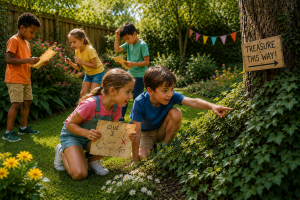
A Treasure Hunt is one of the most flexible and magical party games for children because it can be adapted to almost any age, location, or party theme. Some treasure hunts are energetic outdoor adventures with running and searching, while others are calm indoor clue games where children work together to solve small puzzles and discover hidden surprises.
Many children love treasure hunts because they feel like stepping into a story. Suddenly the garden becomes a jungle, the living room becomes a pirate ship, or the hallway becomes part of a secret mission. Even very simple treasure hunts often create a feeling of excitement and adventure.
The basic idea is easy. Children follow clues, maps, riddles, arrows, or hidden objects until they eventually discover the final treasure. The treasure itself does not need to be expensive. Small sweets, stickers, pencils, tiny toys, party bags, or even homemade certificates can work perfectly well.
Treasure hunts have existed for generations and are inspired by old adventure stories, pirate tales, and hidden-map games. Over time they became one of the most popular birthday party activities because they combine movement, teamwork, imagination, and problem-solving in a natural way.
One of the nicest things about treasure hunts is that they can easily be adjusted for different age groups. Younger children often enjoy simple visual clues, coloured arrows, or picture trails, while older children may prefer riddles, secret messages, puzzles, or small challenges between clues.
The game works beautifully outdoors in gardens, parks, or playgrounds, but indoor versions can be just as fun on rainy days. Some families even create whole-house treasure hunts using bookshelves, pillows, cupboards, and hidden corners as clue locations.
Treasure hunts are usually best for children between four and twelve years old, although teenagers sometimes enjoy more complicated mystery or escape-style versions as well.
Supervision depends on the age group and the location. Younger children usually need adults nearby to guide the game gently and prevent clues from being skipped accidentally. Older children often enjoy solving clues more independently.
CLARA’S TIP
Treasure hunts do not need to be complicated to feel magical. Even a short hunt with four or five clues can feel exciting when the clues are hidden thoughtfully and the story sounds adventurous.
Children often remember the atmosphere much more than the prize itself.
Variations Of Treasure Hunts
There are endless ways to change a treasure hunt depending on the party theme. Pirate hunts are especially popular, with maps, hidden gold coins, and secret messages. Nature hunts work beautifully outdoors, where children search for leaves, stones, flowers, or hidden animal pictures.
Some treasure hunts use riddles, while others rely on simple arrows or picture clues for younger children. Teams can also work together instead of competing, which often creates a calmer and friendlier atmosphere.
For evening parties, torchlight treasure hunts can feel especially exciting for older children.
Safety Notes
Treasure hunts work best when the search area is clearly defined and safe. Avoid hiding clues near roads, staircases, ponds, fragile decorations, or dangerous tools. Younger children often enjoy the game more when adults quietly guide the group without rushing them.
What is a Treasure Hunt?
A treasure hunt is a game where children follow clues or search for hidden objects until they discover a final prize or treasure.
What age is best for a Treasure Hunt?
Treasure hunts can be adapted for almost any age, although children between four and twelve years old usually enjoy them most.
Can a Treasure Hunt be played indoors?
Yes. Indoor treasure hunts are very popular during rainy weather or smaller home parties.
What can be used as treasure?
Small sweets, stickers, pencils, toys, party bags, or certificates can all work very well as treasure.
How many clues should a Treasure Hunt have?
Most children’s treasure hunts work well with around four to ten clues depending on the age group.
Are Treasure Hunts good for birthday parties?
Yes. They are one of the most popular birthday party games because they combine adventure, teamwork, and excitement.
Can younger children do a Treasure Hunt?
Yes, although younger children usually enjoy picture clues or simple directions more than difficult riddles.
How long does a Treasure Hunt usually last?
Most treasure hunts last between fifteen and forty-five minutes depending on the number of clues and the size of the area.
YOU MAY ALSO LIKE
Looking for more games? Visit Clara’s Birthday Game System to explore all birthday party games and activities.