

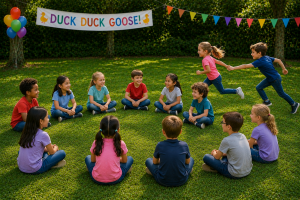
Duck Duck Goose is one of those traditional children’s games that has survived for generations because it is simple, active, and surprisingly exciting for young children. The game needs almost no preparation and works well at birthday parties, school events, playgroups, and family gatherings. It is especially useful when children need a quick game that gets everybody involved without complicated rules.
The game begins with the children sitting in a circle on the floor or on the grass. One child walks slowly around the outside of the circle, gently tapping each seated player on the head while saying “duck… duck… duck…” The tension slowly builds because nobody knows when the walker will suddenly choose somebody as the “goose.”
The moment the word “goose!” is shouted, the chosen child jumps up and chases the runner around the circle. The goal is for the runner to sit in the empty place before being caught. If the runner succeeds, the new child begins the next round. If not, the same player may need to try again.
Nobody knows exactly where the game first began, but versions of Duck Duck Goose have existed for many decades and remain popular in many countries. Some regions even use slightly different names or rules, but the basic idea stays the same: suspense, movement, and laughter.
Duck Duck Goose is usually best for younger children, especially between about three and eight years old. Older children sometimes enjoy it too, particularly when they become very dramatic or silly while choosing the next goose. Younger children often love the excitement of waiting and wondering when their turn will come.
The game works both indoors and outdoors, although many people prefer playing it outside because children have more room to run safely. Indoors, a carpeted floor or soft play area usually works best.
One reason Duck Duck Goose works so well at parties is that everybody stays involved almost the entire time. Even children who are sitting and waiting remain curious and alert because they know they might suddenly become the next goose.
Supervision is usually light, although adults may need to help very young children understand the rules or encourage shy children to join in.
CLARA’S TIP
Very young children sometimes become nervous about chasing or being chased. A softer version can help by turning the running into hopping, waddling, or tiptoeing instead. This often keeps the game funny and calm rather than overly competitive.
Children also love themed versions where the words change. Instead of “duck” and “goose,” you can use animals, colours, foods, or party themes.
Variations Of Duck Duck Goose
There are many simple ways to adapt the game. Some groups use animal names, while others make the players move in funny ways such as hopping like frogs or stomping like dinosaurs. During themed parties, children sometimes use words connected to the party itself, such as “pirate” and “captain” or “princess” and “dragon.”
For larger groups, two runners can even be chosen at the same time, which usually creates a lot of laughter and confusion.
Safety Notes
Because children suddenly jump up and run, it helps to make sure there is enough space around the circle. Indoors, slippery floors and sharp furniture corners should be avoided. Younger children often enjoy the game more when adults encourage gentle movement instead of fast competitive chasing.
What is Duck Duck Goose?
Duck Duck Goose is a traditional children’s circle game where one child walks around the group and chooses another child to chase them.
What age group is best for Duck Duck Goose?
The game is especially popular with children between three and eight years old.
Can Duck Duck Goose be played indoors?
Yes. Many families and schools play it indoors, especially in classrooms or halls with enough space.
Does Duck Duck Goose need any materials?
No. The game only needs enough space for children to sit in a circle and move safely.
Why do children enjoy Duck Duck Goose so much?
The game creates suspense because nobody knows who will suddenly become the goose.
Can toddlers play Duck Duck Goose?
Yes, although younger children usually enjoy slower and gentler versions.
How long does Duck Duck Goose last?
Most groups play for around ten to twenty minutes, depending on the size of the party.
Can Duck Duck Goose be adapted for themed parties?
Yes. Many people change the words to match animals, holidays, pirates, princesses, or birthday themes.
YOU MAY ALSO LIKE
Looking for more games? Visit Clara’s Birthday Game System to explore all birthday party games and activities.