

Many children enjoy surprises, and many older people enjoy sharing memories. This activity combines both. A grandparent, parent, neighbour, or other adult places several interesting objects into a bag without showing them to the child. The child reaches inside, feels one object, and tries to imagine what it might be.
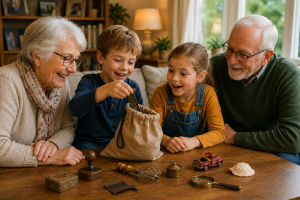
Once the object has been chosen, the child is encouraged to invent a story about it. Perhaps the object belonged to a pirate, travelled around the world, or was found during an exciting adventure. There are no wrong answers, and the more imaginative the story becomes, the more enjoyable the activity often is.
After the story has been told, the adult can reveal the real object and share its true history. Sometimes the object will have a genuine family connection. Other times it may simply be an everyday item with an interesting purpose. Either way, the activity creates conversation and often leads to laughter as everyone compares the imagined story with reality.
The objects do not need to be valuable or unusual. A key, an old kitchen tool, a pocket watch, a sewing item, a small toy, a shell from a holiday, or a decorative ornament can all work well. The mystery is often more important than the object itself.
One enjoyable variation is to ask the child to tell their story first and then invite the older person to share a real memory connected to the object. In this way, imagination and family history come together in a natural and relaxed way.
What You Will Need
– A bag, basket, or box
– Several interesting objects
– A child
– A grandparent, parent, neighbour, or other adult
– A little imagination
Why This Activity Works
Children enjoy guessing, imagining, and creating stories. Older generations often enjoy sharing memories and experiences. Because both happen naturally during the activity, conversations develop without feeling forced. Many families discover that a simple object can lead to stories that might otherwise never have been told.
What kinds of objects work best?
Objects that feel unusual, have an interesting shape, or have a story attached to them often work particularly well.
Does the child need to identify the object correctly?
No. The guessing is only part of the fun. Imagination is encouraged.
What age is this activity suitable for?
Most children from about five years old can enjoy the activity, although older children often create more detailed stories.
Can photographs be used instead of objects?
Yes. Printed photographs can be placed in an envelope and revealed after the story has been told.
What if the child is shy?
Adults can help by asking questions and building the story together.
Why is this activity good for different generations?
It combines imagination, conversation, memories, and storytelling in a way that encourages everyone to participate.
YOU MAY ALSO LIKE
Guess the Object, Hear the Story