

Sometimes the simplest objects can create the most interesting stories. In this activity, a child and an older family member choose three unrelated objects and use them to create a story together.
The objects can be almost anything. A key, a spoon, and a toy car. A shell, a photograph, and a button. A pine cone, a pencil, and a teacup. The stranger the combination, the more interesting the story often becomes.
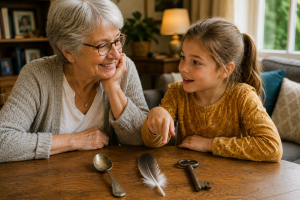
Place the three objects on a table and spend a moment looking at them. The child can begin the story, or the older person can start. One object might become a treasure, another a clue, and the third the solution to a mystery. There are no right or wrong answers.
As the story develops, each person adds new details. One object might suddenly become important later in the adventure. The activity often leads to surprising ideas, laughter, and creative conversations.
Older family members can also connect the story to real memories. A simple object may remind them of childhood, school, holidays, work, or family traditions. In this way imagination and family history naturally come together.
What Are Good Objects To Use?
Almost any objects can work. Everyday household items are often best because they encourage creative thinking. Children frequently create the most imaginative stories when the objects have no obvious connection to one another.
What You Will Need
All you really need are three objects, a child, an older family member, and a little imagination. The objects do not need to be special. Everyday household items often create the most interesting stories.
Why This Activity Works
Children enjoy inventing stories and solving creative problems. Older generations often enjoy conversation and sharing memories. Because everyone contributes to the same story, the activity feels natural and relaxed rather than structured or formal.
Can The Story Be Silly?
Yes. Silly stories are often the most enjoyable. A flying teacup, a treasure-hunting spoon, or a talking button can all become part of the adventure.
What If Someone Gets Stuck?
Simply ask a question such as “What happened next?” or “Where did the object come from?” The story can continue in any direction.
What Age Is This Activity Suitable For?
Most children from about five years old can join in. Older children often create longer and more detailed stories.
Can We Use Photographs Instead Of Objects?
Yes. Old photographs, postcards, or printed pictures can work just as well.
Why Is This Activity Good For Different Generations?
It combines imagination, conversation, creativity, and shared time together in a simple activity that everyone can enjoy.
YOU MAY ALSO LIKE
Guess the Object, Hear the Story